*WARNING*: Mild Spoilers ahead for the early game and also some gameplay aspects.
When booting up this game for the first time, the last thing I expected was to be entranced by the haunting beauty of the menu screen. Eerie music played as moonlight shone in through a moss-covered window, and hundreds of rats scurried across the floor. So many, you could not even see the cobblestone beneath. The graphics, the music, the setting. All of this shooting out at me before I even started the game.
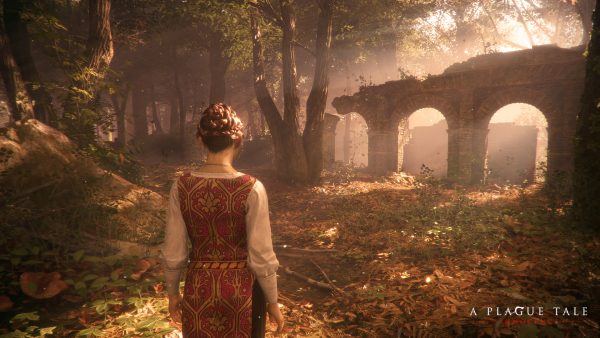
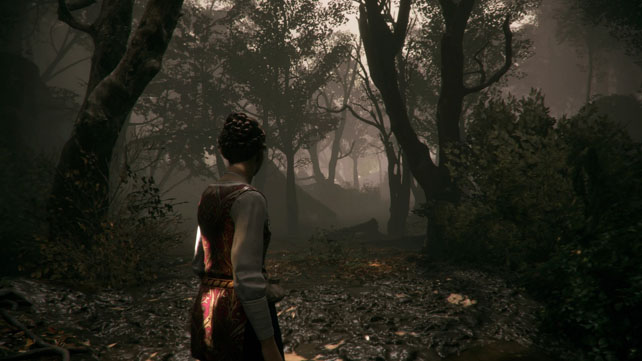
Once I did manage to pry myself from the title screen, I started the game and was promptly shown once again just how amazing the graphics can be. We’re introduced to our protagonist – Amicia – and her father in the middle of the forest with Amicia’s dog, Lion. The mood of the game so far is peaceful, quiet, and happy. But then Lion runs off after a boar, and Amicia chases after him. What I noticed, however, was that the deeper into the woods Amicia ran after her dog, the more ominous the tone became. The orange light of the forest turned dark, the beautiful trees now rotten, the ground muddy. This is a fantastic display of visual storytelling. When Amicia finds Lion, he is injured. Amicia’s father, Robert, catches up, and Lion only manages a small whine before he is dragged below the ground by some mysterious creature. This is just a taste of the tragic events to come in this game.
When Amicia and her father return to the homestead, Amicia is told to go see her mother in the house. I could have gone straight to the house and progressed the story, but after a bit of exploring, I found a small interaction at the church. Something that I can’t believe I almost missed. Amicia will go to the altar and say her final goodbye to “My darling dog”. A moment like this was so small, yet so impactful. This happens throughout the game, where the player is rewarded for exploring the area with small moments of closure or funny lines of dialogue. Just something a little extra for those that want to immerse themselves further into the world. That shows to me that the developers truly care about this world and the characters within it.
Shortly after, we are introduced to the secondary protagonist, Hugo, Amicia’s sick little brother. Amicia has rarely seen her brother, so when they come face to face, Amicia has to introduce herself as his sister. But an introduction is all they have time for, as their homestead is invaded by the Inquisition. The man leading the assault is Nicholas, who is definitely up there on the coolest looking villains list.

It is after this where the game truly begins. And it begins with an intense stealth section where Amicia and Hugo have to escape the homestead. So I did, distracting guards and sneaking through bushes, Hugos’s hand grasped firmly in Amicia’s, watching in horror as every servant I spoke to as I explored the area was taken out by the Inquisition’s soldiers. After finally escaping the homestead, I falsely believed that I could have a moment of reprieve to process all that had happened. But then the ground began to rumble, and as if bombs were being detonated, the earth exploded as Amicia and Hugo ran for their lives. The Inquisition soldiers began screaming, and the ground continued to explode around us. It became clear that whatever creatures were responsible for the untimely demise of Amicia’s dog were on a rampage. We find out later that these creatures are rats. Swarms and swarms of rats, like in the menu screen.
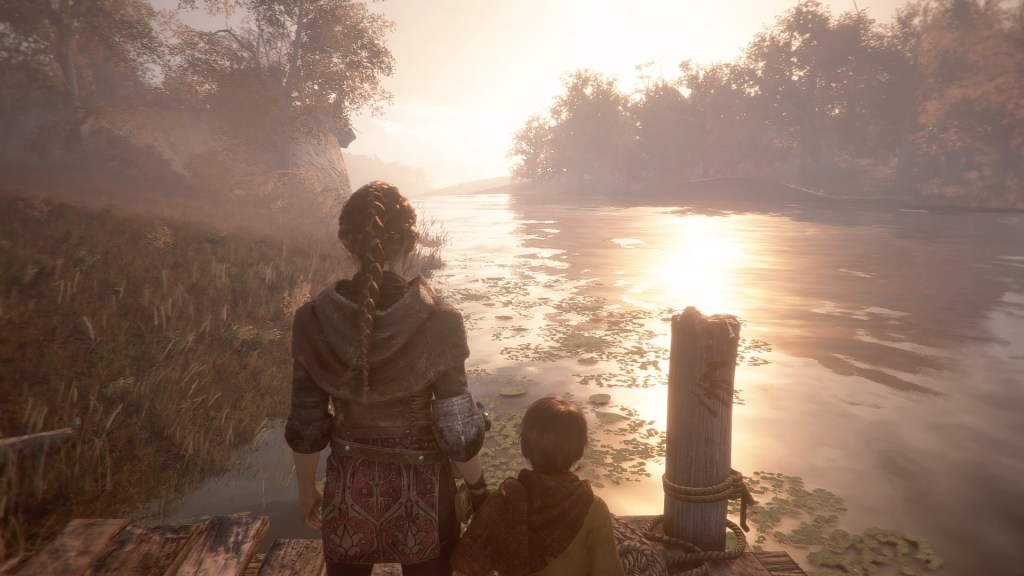
Finally, Amicia and Hugo managed to escape, and I was rewarded with a small moment of quiet to reflect on all that had happened. Amicia and Hugo were now all alone.
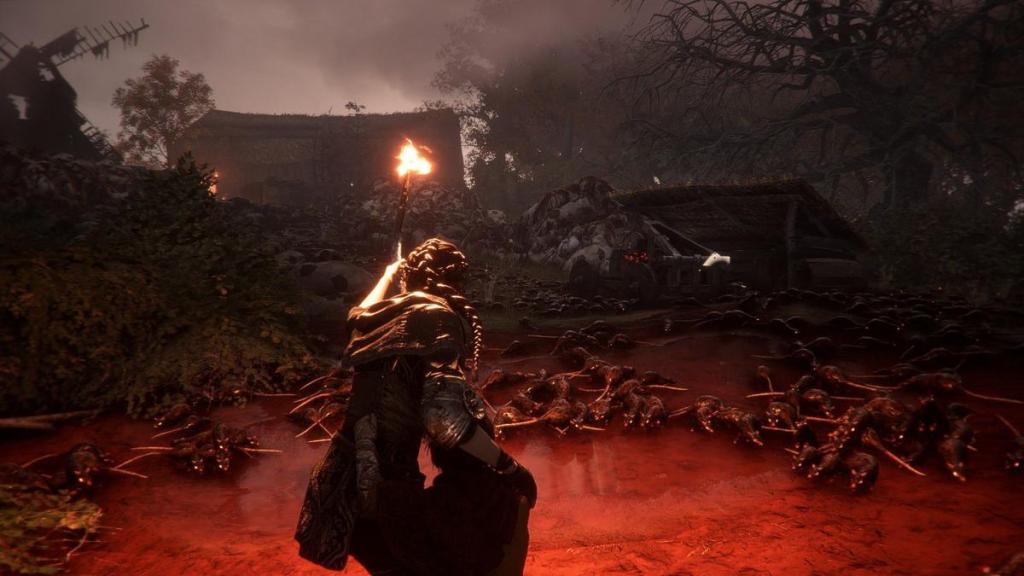
A Plague Tale has no issues forcing you to make decisions that ensure your survival, while dooming others. There is a moment in this game where Amicia must get through a hallway of rats to escape. But at the other end of the hallway is a man trying to escape himself. The swarm of rats fear light, so Amicia – torch in hand- slowly walks through the hallway with her brother, guiding the rats away from her… and straight towards the man. I’ll never forget that mental image of Amicia desperately apologizing to the man who is pleading for his life. But in this world, it’s survival of the fittest, and we watch as the man becomes the rats’ next meal so that Amicia and her brother can escape. Chilling.
That’s all of the story I feel I should reveal, as I highly encourage anyone who hasn’t bought this game to get it as soon as possible. But now, let’s move on to another aspect of the game; one that was originally somewhat unimpressive, but slowly reached satisfying heights. The gameplay.
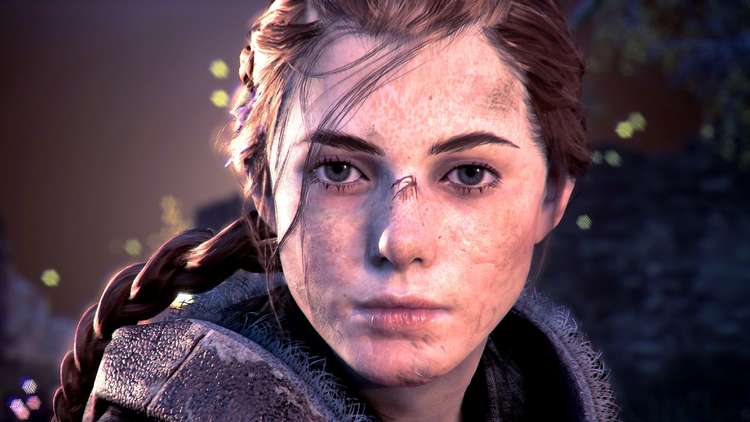
The gameplay at the beginning of A Plague Tale is mostly stealth. When you’re not sneaking past enemies, you’re running from them. Amicia has a slingshot, but in the first hour, it can only stun enemies. This is where I found myself very impressed with the pacing of this game, both in story and gameplay. Just as I was beginning to tire of sneaking past enemies, the game gives me an upgrade to Amicia’s slingshot that can kill enemies with one rock to the head. They then introduce me to a tense boss fight where I have to utilize this new ability. The kind of tutorial I wish all games had.
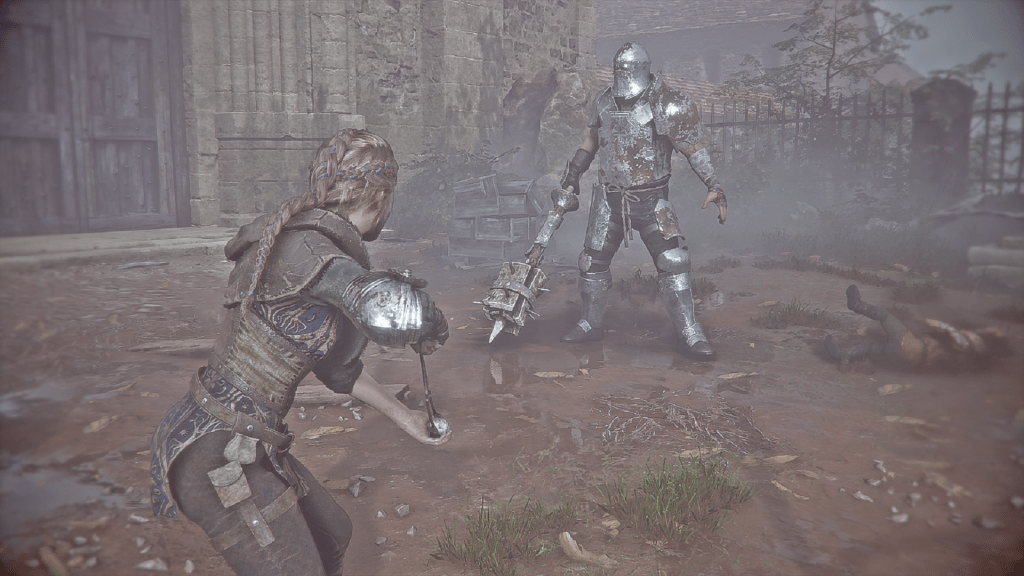
This immediately adds a bit of power for Amicia in her slow but steady progression from frightened teenager, to an unstoppable force who is a crack shot with a sling. The slingshot is a one hit kill with a headshot, but then you face enemies with helmets. Later, you get an item that can melt those helmets off, leaving them vulnerable to a rock in the head. Then you meet enemies in very heavy armor whose helmets can’t be melted, and only a few hours later, you get to control a character that can take them out specifically. The progression in this game never gets repetitive or old, as they keep refreshing the gameplay with new and useful tools.
But beyond sneaking past men, or slingshotting everyone in your path, this game has another enemy. The rat swarms…
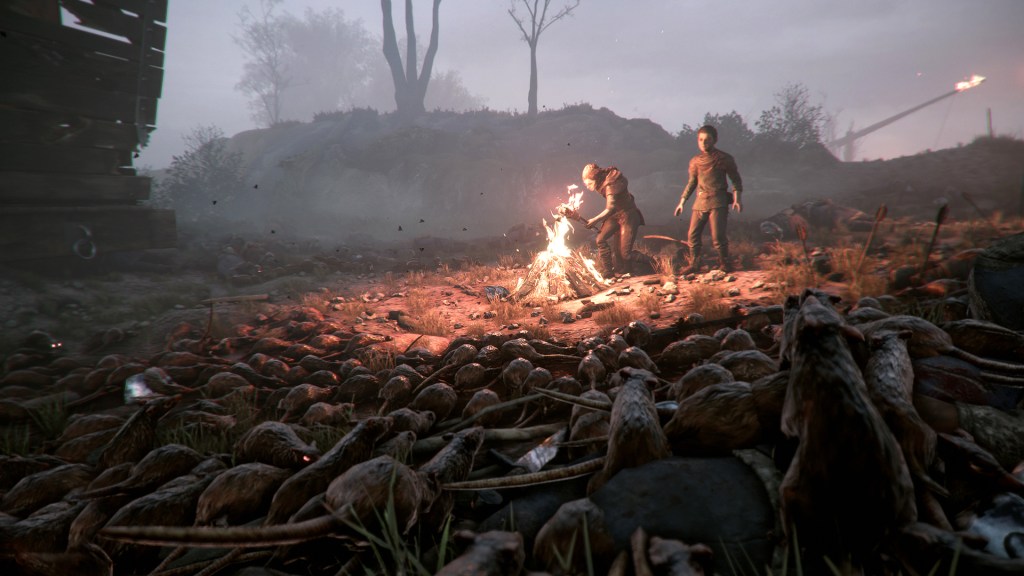
A Plague Tale uses rats as more of a deadly puzzle than an enemy to fight, though you do get more tools that can be used to kill or distract these pesky rodents. But even when I was safe in the light of a fire, watching the swarms of rats surrounding me just waiting for the fire to go out, I couldn’t shake the unease it brought me. Sometimes I was only given a stick to light on fire and slowly wade through the sea of rats, knowing that the fire would go out within seconds, and if I wasn’t quick, it would be the last of Amicia and her brother. The puzzles are never very complicated, but there’s enough substance in them to make you feel good when you solve them. I never once felt frustrated at a puzzle, and I think they are well made for a story-focused game, especially with the horror aspect the rats so generously bring.
A Plague Tale really knows what it wants to do. The pacing of story and gameplay is incredible, the characters are all believable and have their own motivations, and you’re never left with a question for too long before it is answered and another question takes its place. This is one of those games I will never forget, and some of the story moments are especially seared into my memory. I sincerely hope we get a sequel to this game. I would love to see what’s next for this brother and sister duo.
 A.K. Rohner